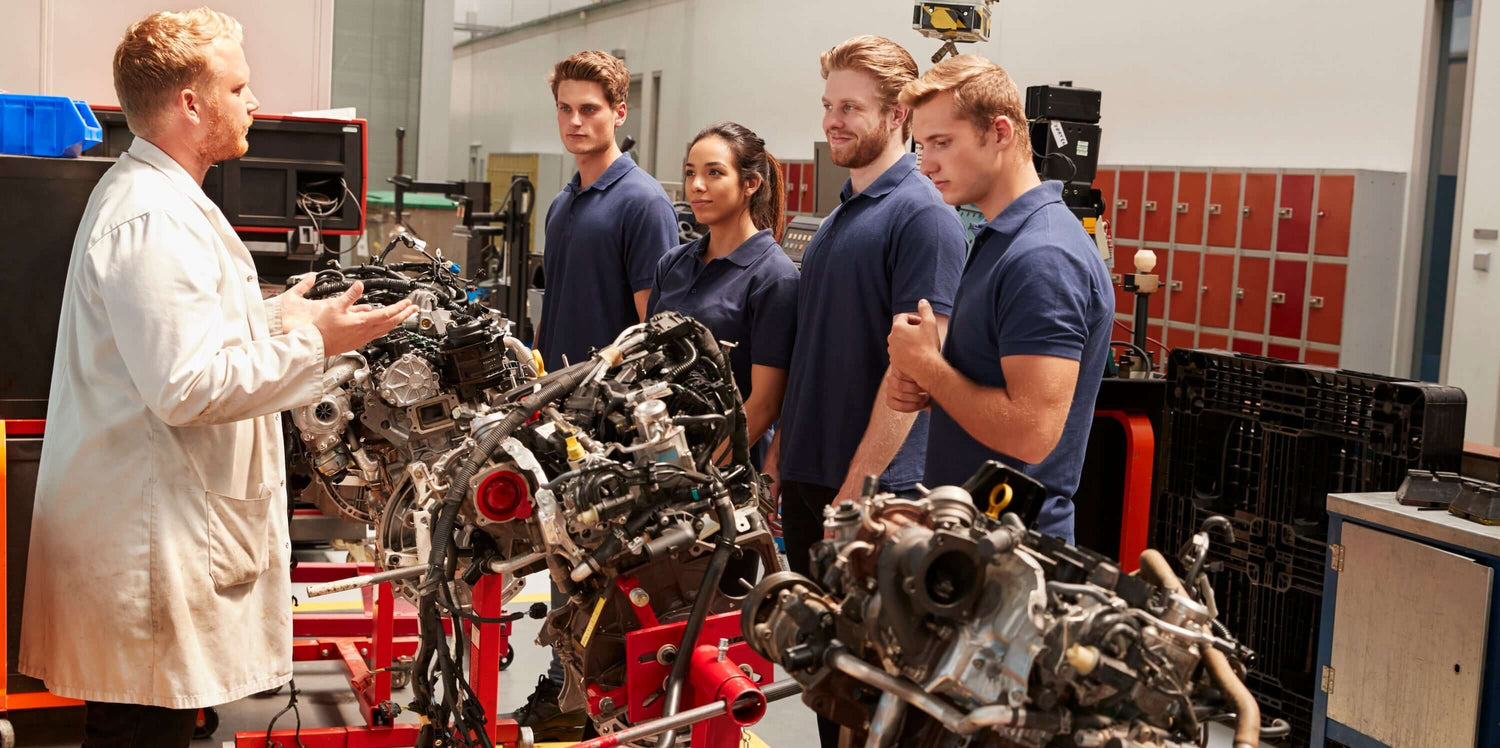

Pulling a Honda engine at home is one of those projects that has a reputation for being achievable, and that reputation is mostly earned. Honda engineering tends to favor mechanical clarity — components are accessible, fasteners are mostly standard metric sizes, the wiring is well-organized. The places where home garage Honda projects stall aren't usually mechanical surprises. They're prep failures and impatience with sequence.
This walkthrough is the prep-and-removal sequence experienced shops use on Honda engine pulls, with the Honda-specific quirks that catch out techs who treat every engine like the last one they did.
Before the Hood Comes Up
Spend the first hour on prep, not on bolts. Have ready: a clean workbench or shelving for parts; gallon zip-top bags and a sharpie for fastener groups; an engine stand rated for at least 1,000 pounds with the correct adapter for your Honda engine family; an engine hoist with a load leveler; a transmission jack if you're separating; drain pans for coolant and oil; a stack of rags; good shop lighting.
Tools the average home garage doesn't have but ends up needing on Honda pulls: 8mm and 10mm flex-head ratchets (Honda uses these sizes in tight engine bay spots), JIS-pattern screwdrivers (looks like Phillips, isn't — Honda fasteners that look like Phillips heads strip out under a regular Phillips bit), a magnetic pickup tool, and a scan tool capable of communicating with Honda PCMs.
Step 1: Photograph Everything
Before disconnecting anything, walk around the engine bay with a phone camera and take fifty photos minimum. Cover every angle. Vacuum line routing, every connector orientation, every hose clamp position, accessory belt routing. Photograph the ground straps where they bolt to the block, the firewall, the chassis. Above, sides, below if you can.
Honda harnesses have multiple connectors that look almost identical — cam position sensors, VTEC solenoid connectors, VTC oil control valves, coolant-related sensors. Photos at disconnect time eliminate the guessing on reassembly.
Step 2: Drain Fluids
Coolant first. Let the engine cool completely. Open the radiator cap, position a drain pan under the lower radiator hose, and crack the hose connection. On most Honda engines there's also a block drain plug on the side of the block — cracking that plug after the radiator drain catches the coolant trapped in the block galleries. Skipping the block drain leaves coolant in the engine that will spill when you tip the engine onto the stand.
Engine oil second. You're discarding the engine, but draining the crankcase before the pull makes the engine lighter to lift and prevents oil from spilling on the floor at the worst moment.
For automatic and CVT applications, leave transmission fluid alone if you're separating at the bell housing. For Honda CVT-equipped vehicles specifically, handle the transmission with extra care during separation — the CVT internals are more delicate than conventional automatics and the torque converter equivalent damages easily if it swings free.
Step 3: Battery and Fuel
Disconnect negative terminal first, then positive. Remove the battery entirely. Relieve fuel system pressure before disconnecting any fuel line. On most modern Hondas, pulling the fuel pump relay (check the underhood fuse box diagram) and running the engine until it stalls bleeds line pressure to near zero. Cap or plug fuel lines immediately as they disconnect.
For 1.5T applications, the high-pressure fuel system holds pressure substantially longer than naturally aspirated engines. Verify pressure has dropped before disconnecting high-pressure lines.
Step 4: Remove Accessories
Work top-down. Air intake assembly off including resonator and intake tube. Engine cover off if equipped (Honda engine covers often have hidden retaining clips beyond visible bolts — don't pry). Serpentine belt off, with routing marked on the cover before removal. Alternator unbolted and lifted off.
A/C compressor unbolted and tied back without disconnecting refrigerant lines. Power steering pump unbolted and tied back similarly. Exhaust manifold or downpipe off. Honda exhaust manifold studs are generally cooperative compared to other manufacturers, but soak them with penetrating oil overnight before removal anyway.
Step 5: Wiring Harness
This is where the photos pay off. Work methodically through every electrical connector, releasing locking tabs and pulling straight back. Most Honda connectors use a primary press-tab with a secondary slide-lock that must be released before the primary tab.
Label every connector with painter's tape and a sharpie. The cam position sensor on a K-series can be confused with the VTC oil control valve on reassembly if you're working from memory. Label, don't memorize.
The main engine harness on most modern Hondas routes through a firewall bulkhead. Locate it, release the locking mechanism (usually a swing lever or a slide-and-lift design), and pull the connector straight back. Engine harness comes out with the engine on most applications.
Step 6: Cooling and Subframe
Remove radiator hoses, heater hoses (cap or plug heater core fittings), and any auxiliary cooling lines. Electric fan platforms need only the fan electrical connector disconnected and the shroud out of the way.
On most modern Honda applications, the engine and transmission come out together through the bottom of the vehicle. The subframe and front suspension drop with the engine. This is a lift-required job for most applications and not really suitable for home garage work without proper equipment.
On older Honda platforms (1990s Civics, older Accords, older Integras), the engine often comes out the top with the transmission staying in the vehicle. Different procedure, generally more home-garage-friendly.
Step 7: Separate the Transmission (if applicable)
For top-removal applications, mark the torque converter to the flexplate before unbolting. Remove the torque converter bolts through the access hole at the bottom of the bell housing. Rotate the crank by hand to bring each bolt into view. Don't miss any.
Support the transmission with a jack stand before unbolting the bell housing. Manual transmission applications follow the same principle but without converter bolts.
Step 8: The Lift
Attach engine hoist chains to the factory lift points. On K-series engines these are typically on the cylinder head at opposite corners. On J-series V6 engines the lift points are on the heads themselves. Use a load leveler.
Raise the engine just enough to take weight off the motor mounts, then unbolt both mounts from the block. Lift slowly. Watch the rear of the engine clear the firewall and the front clear the radiator support.
Step 9: Mount on the Stand
Mount the engine on the stand using the correct flywheel-pattern adapter plate. All four bolts. Once it's secure, inventory what's transferring to the new engine. Harmonic balancer, flexplate or flywheel, oil pan if transferring, valve cover, accessory brackets, intake manifold if transferring. Clean each part. Replace any gasket or seal you're touching.
Prep Tips for the Install
Lay parts in install order. Photograph their orientation. Replace every wear item you can while access is easy — motor mounts, rear main seal, water pump, thermostat. For K-series specifically, this is the right time to replace the VTEC solenoid screen if you're not already doing it during the rebuild. For J35 with VCM, evaluate whether the VCM hardware on the replacement engine has been addressed in the rebuild scope.
Before the new engine arrives, verify fitment one more time against casting numbers on the old engine. Sourcing from our Honda engine catalog with documented casting numbers and platform fitment removes this question before the engine ships.
And clean the engine bay while it's empty. Pressure-wash the firewall, the inner fenders, the chassis members. The half hour spent on cleanup is what turns an engine swap into a refresh that looks like new work when the customer sees the engine bay for the first time.