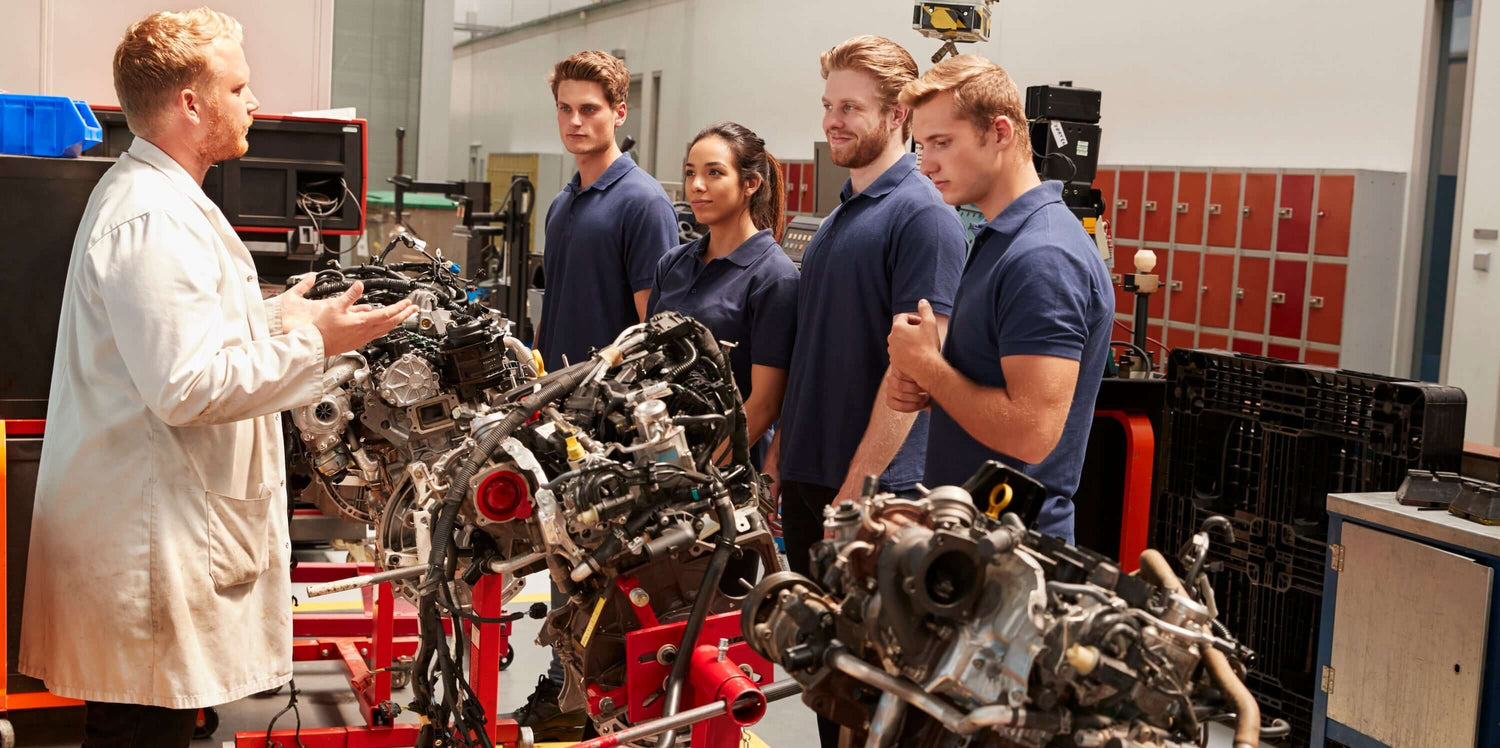

Pulling an engine out of a Lincoln is one of those jobs where the published Ford service procedure tells you most of what you need to know but not all of it. Lincoln vehicles share engine architecture with their Ford counterparts but live inside bodies built to different NVH targets, with extra sound deadening, additional accessory routing, and a tighter engine bay that complicates the work in ways the Ford service manual doesn't always anticipate. Independent shops that work on both platforms learn to budget more time for the Lincoln version of the same job.
This walkthrough is the prep-and-removal sequence experienced shops use on Lincoln engine pulls, with the platform-specific notes that keep the install side from being harder than it has to be.
Before You Start
Spend the first hour on prep, not on bolts. The mistake that costs the most time isn't a wrong torque value — it's starting the disassembly without somewhere clean and labeled to put the parts as they come off.
Have ready: a clean workbench or shelving for parts; gallon zip-top bags and a sharpie for fastener groups; an engine stand rated for at least 1,000 pounds with the correct mounting plate for your Lincoln engine family; an engine hoist with a load leveler; a transmission jack if you're separating the transmission; drain pans for coolant, oil, and possibly transmission fluid; a stack of rags; good shop lighting under the hood.
Tools the average home garage doesn't have but ends up needing on Lincoln pulls: a long-reach Torx bit kit (Lincoln bell housing bolts and various brackets use E-Torx and internal Torx in tight spots), an 8mm flex-head ratchet for buried accessory bolts, a balancer holding tool sized for your specific engine family, and a scan tool capable of reading and clearing Lincoln-specific PCM codes after the reinstall.
Step 1: Photograph Everything
Before a single connector comes off, walk around the engine bay with a phone and take fifty or more photos. Cover every angle. Get the routing of every vacuum line, every wiring connector orientation, every hose clamp position, every accessory belt routing. Photograph the ground straps where they land on the block, the firewall, and the chassis.
This is the single most useful prep step on Lincoln pulls. Lincoln harnesses have additional connectors for premium features that Ford service documentation doesn't always cover — active engine mount connectors on some platforms, premium audio routing that shares space with engine harness routing, additional sensors for traction and stability control. The published Ford service manual doesn't always show these. Your photos will.
Step 2: Drain Fluids
Coolant first. Let the engine cool completely. Open the radiator cap (or remove the degas bottle cap on platforms without a traditional radiator cap), position a drain pan under the lower radiator hose, and crack the hose connection. Drain coolant fully from the radiator side. On most Lincoln V8 and V6 applications there's also a block drain plug on the side of the block — cracking that plug after the radiator drain catches the coolant trapped in the block galleries. Skipping the block drain leaves coolant in the engine that will spill when you tip the engine onto the stand.
Engine oil second. Drain the crankcase before the pull. The engine is heavier than it needs to be with oil in it, and a partial spill during the lift is exactly the kind of small disaster that turns a clean job into a memorable mess.
For automatic transmission applications, leave the transmission fluid alone if you're separating at the bell housing — the fluid stays with the transmission when the torque converter unbolts from the flexplate. For applications where the engine and transmission come out as an assembly (some Cyclone V6 platforms), follow the published procedure for fluid handling specific to that platform.
Step 3: Battery and Fuel
Disconnect the negative terminal first, then positive. Remove the battery entirely — it's in your way for several upcoming steps and you don't want it near accidental sparks.
Relieve fuel system pressure before disconnecting any fuel line. On most modern Lincolns, pulling the fuel pump fuse or relay (check the underhood fuse box diagram) and running the engine until it stalls bleeds line pressure to near zero. Cap or plug fuel lines immediately as they disconnect. Residual fuel will continue to drip from a disconnected line for hours.
For 3.5L EcoBoost applications, the high-pressure fuel system holds pressure substantially longer than naturally aspirated engines. Relieve pressure with the fuel pump disabled and the engine cycled to stall. Don't disconnect high-pressure fuel lines without verifying pressure has dropped — a pressurized high-pressure line cracked open is not just messy, it can be hazardous.
Step 4: Remove Accessories
Work top-down. Air intake assembly off including the intake tube, resonator, and MAF housing. Engine cover off, if equipped (Lincoln engine covers often have hidden retaining clips beyond the visible bolts — don't pry; check the service procedure). Serpentine belt off, with routing marked before removal if the engine bay doesn't have a routing decal. Alternator unbolted and lifted off its bracket.
A/C compressor unbolted from its bracket and tied back to the chassis without disconnecting the refrigerant lines (unless you've properly evacuated the system, which most DIY projects can't do). Power steering pump unbolted and tied back similarly. Exhaust manifolds off, after generous overnight soaking with penetrating oil on every stud. Lincoln exhaust manifold studs on V8 engines are particularly prone to snapping when removed dry — the same heat-cycling issue that breaks them on F-150s breaks them on Navigators and Town Cars.
For 3.5L EcoBoost applications, the additional turbo-related plumbing has to come off in a specific order. Intercooler hoses first, then wastegate vacuum lines, then the turbo coolant and oil lines. Document the routing carefully — the install order matters and the lines aren't intuitive to reroute from memory.
Step 5: Wiring Harness
Photos pay off here. Work methodically through every electrical connector on the engine, releasing locking tabs and pulling straight back. Lincoln connectors use Ford-style locks but often have secondary slide locks that must be released before the primary tab. Forcing a connector with the secondary lock still set breaks the locking mechanism, which is a separate problem from disconnecting the connector.
Label every connector with painter's tape and a sharpie. Note what it plugs into and where it routes. The cam position sensors on V8 and V6 engines have nearly identical connectors and are easy to misroute on reinstall. Take the time.
The main engine harness on most modern Lincolns routes through a firewall bulkhead. Locate that bulkhead, release the locking mechanism (usually a swing lever on Lincoln applications), and pull the connector straight back. With the bulkhead disconnected, the entire engine harness can come out with the engine, which simplifies the install side considerably.
Step 6: Cooling and HVAC
Remove radiator hoses, heater hoses (cap or plug heater core fittings to prevent residual coolant from dripping through the firewall onto the carpet — happens more often than people expect), and any auxiliary cooling lines like the transmission cooler. On platforms with mechanical fans (older V8 Lincolns), remove the fan and fan shroud before raising the hoist. Electric fan platforms need only the fan electrical connector disconnected and the shroud out of the way.
For 3.5L EcoBoost applications, the intercooler routing has to be addressed before the engine can lift. Remove the intercooler if it's in the way of clearance, or at minimum disconnect the intercooler-to-throttle-body hose to allow the engine to clear during the lift.
Step 7: Separate the Transmission
For automatic transmissions, mark the torque converter to the flexplate before unbolting them — they should reassemble in the same orientation. Remove the torque converter bolts through the access hole at the bottom of the bell housing. Rotate the crank by hand to bring each bolt into view. Don't miss any — a single missed converter bolt will hold the transmission firmly to the engine no matter how much you pull.
Support the transmission with a jack stand or transmission jack before unbolting the bell housing. The transmission will drop several inches once the bell housing bolts are out if unsupported.
For Cyclone V6 applications where the engine and transmission come out as an assembly, skip this step and follow the published procedure for unit removal. The front subframe usually drops with the engine on these platforms, which requires a lift and is generally not a home garage project.
Step 8: The Lift
Attach engine hoist chains to the factory lift points. On Modular V8 engines these are at the cylinder heads opposite corners — front of the passenger-side head and rear of the driver-side head, or vice versa. On Cyclone V6 engines the lift points are similar but on the heads themselves rather than at engine corners. Use a load leveler so the engine angle can be adjusted during the lift.
Raise the engine just enough to take weight off the motor mounts, then unbolt both mounts from the block. Lift slowly. Watch the rear of the engine clear the firewall and the front of the engine clear the radiator support and AC condenser. Tilt the leveler as needed if anything catches. Don't force.
Step 9: Engine Stand and Inspection
Mount the engine on the stand using the correct flywheel-pattern adapter plate for your Lincoln engine family. Use all four bolts. A toppled engine on a stand is an expensive way to end a project.
Once it's secure, inventory what's coming off the old engine to go onto the new one. Harmonic balancer (use the holding tool for installation — Lincoln balancer torques are substantial). Flexplate or flywheel. Oil pan if you're transferring it. Valve covers. Accessory brackets. Intake manifold if it's a transferable component. Clean each as it comes off. Replace any gasket or seal you're touching.
Prep Tips for the Install
Lay the parts you're transferring out on the bench in install order. Photograph their orientation. Replace every wear item you can while access is easy — motor mounts, rear main seal if you're touching it, water pump, thermostat. For Cyclone V6 engines specifically, the internal water pump must be addressed during the swap or it becomes a future problem. For Triton 3-valve engines, evaluate the cam phasers on the replacement engine if the long block didn't come with new ones.
Before the new engine arrives, verify fitment one more time against the casting numbers on the old engine. A surprising number of returns happen at install time because the replacement turned out not to be the correct variant. The match step is cheap; the unwind is expensive. Sourcing from our Lincoln engine catalog with documented casting numbers and platform fitment removes this question before the engine ships.
And clean the engine bay while it's empty. You're never going to have better access than right now. Pressure-wash the firewall, the inner fenders, and the chassis members. Touch up paint chips. Inspect for hidden corrosion. The half hour spent on cleanup is the half hour that turns an engine swap into a refresh that looks like new work when the customer sees the engine bay for the first time.