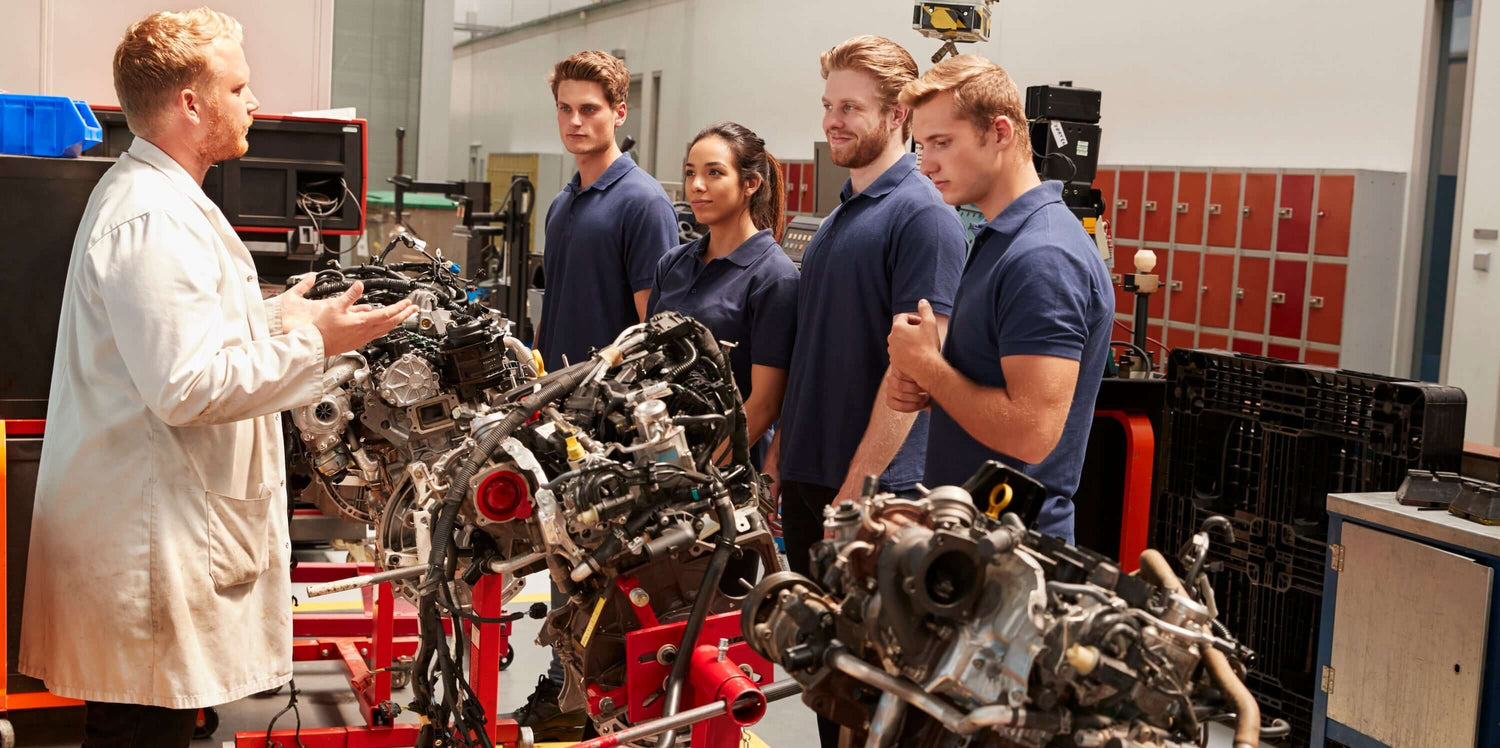

Lincoln engines occupy a strange space in the shop world. They share Ford's engineering foundation but live in vehicles built to a different standard — quieter NVH targets, more sound-deadening packed around the engine bay, more accessories crowding the work area. The mechanical work isn't dramatically different from the Ford equivalent. The access, the disassembly sequence, and the prep all have their own quirks that catch out techs who treat a Lincoln like a slightly fancier F-150.
This guide is the playbook our techs reach for when a Lincoln engine arrives on the bay. It covers what's consistent across the lineup, the engine-family-specific gotchas, and the prep that separates clean Lincoln swaps from comebacks.
Identify What You're Working With
Lincoln's engine lineup reads as a who's-who of Ford engine families. The 4.6L and 5.4L Modular V8s power Town Cars, Navigators, and Aviators of the 1990s through 2010s. The 3.5L and 3.7L Cyclone V6s power MKZ, MKT, MKS, and other midsize Lincolns from the late 2000s onward. The 3.5L EcoBoost twin-turbo V6 powers later Navigators and other premium applications. The 2.0L and 2.7L EcoBoosts cover smaller modern Lincolns.
Each engine family has its own personality. The Modular V8s are mechanically simple and well-documented, but each generation has its specific weak points. The Cyclone V6s share architecture across Ford and Lincoln applications. The EcoBoosts add turbocharging complexity that changes the install sequence meaningfully.
Verify the engine before you order. The eighth character of the Lincoln VIN identifies the engine code. Cross-reference against the model year's specification chart. Then physically check the casting numbers on the block and head against what the VIN says. Mismatches indicate a previous engine swap and tell you to source a replacement matching what's actually installed.
Pre-Install Inspection
Before any wrench touches the vehicle, inspect the replacement engine on the stand. Rotate the crankshaft one full turn by hand — feel for tight spots, listen for any internal contact, confirm timing marks haven't moved in transit.
For 5.4L Triton 3-valve engines specifically, pay attention to the cam phaser condition on a reman unit. The 3-valve has documented cam phaser issues across its production life, and a reman engine that didn't address them is shipping you a known problem. Reputable rebuilders publish cam phaser replacement as part of the rebuild scope. Confirm in writing before purchase.
For 3.5L EcoBoost engines, the turbo condition matters as much as the long block condition. A bench-tested EcoBoost turbo is a different product than a reman long block with carryover turbos of unknown history. The supplier should disclose which one you're buying.
Pulling the Old Engine: Lincoln-Specific Notes
Lincoln engine bays are crowded compared to Ford equivalents. The sound deadening, the additional accessory routing, the cabin firewall depth — all of it eats into working space. Plan extra time for the disassembly compared to what the Ford equivalent would take.
On Navigators and Aviators with V8 power, the engine usually comes out the top with the body still on the frame. Some applications require the radiator support to come off as a unit; others allow it to stay. Check the service procedure for the specific year and model before assuming.
On MKZ, MKS, and other Cyclone V6 applications, the engine and transmission usually come out together as an assembly through the bottom. The subframe and front suspension drop with the engine on most platforms. This is a lift-required job for most of these applications and not really suitable for home garage work.
On 3.5L EcoBoost applications, the intercooler routing and the dual turbo plumbing add disassembly steps that aren't on the naturally-aspirated equivalent. Photograph the intercooler hoses, the wastegate vacuum routing, and the turbo oil and coolant lines in detail before disconnecting anything.
Disconnecting the Wiring
Lincoln wiring harnesses use the same Ford connector designs but with additional connectors for premium features — active engine mounts on some platforms, additional emissions sensors on some applications, premium audio interfaces that share routing with engine harnesses on others.
Photograph every connector before disconnecting. Label each with painter's tape and a sharpie. The cam position sensors on V6 and V8 engines have nearly identical connectors and are easy to misroute on reinstall. Take the extra time.
The main engine harness routes through a firewall bulkhead on most modern Lincolns. Locate it, release the locking mechanism (usually a swing lever or a slide-and-lift design), and pull the connector straight back. With the bulkhead disconnected, the entire engine harness comes out with the engine on most applications.
Prepping the Replacement on the Stand
Transfer accessory brackets, alternator, power steering pump (where present), A/C compressor, and any sensors not pre-installed. Use new bolts for the flexplate — Ford and Lincoln flexplate bolts are typically torque-to-yield and shouldn't be reused.
For Modular V8 engines, the harmonic balancer torque is substantial — typically 100–130 lb-ft depending on application — and requires a balancer holding tool to install correctly. An impact gun is not the right tool here.
Install a new oil filter and pre-fill the oil galleries. For Cyclone V6 engines, the oil filter mount has internal galleries that need priming before first crank. A drill-driven oil pump primer is the most reliable way to confirm pressure before the engine fires.
If the old intake manifold is being reused, inspect it for cracking — the 2-valve Modular V8 intake manifolds are notorious for cracking around the coolant passages, and a swap is the right time to address that. New intake manifolds for these engines are widely available and inexpensive relative to the labor cost of doing the intake later.
The Drop-In
Lower the engine into the bay slowly, with the transmission disconnected and the engine mounts ready to receive it. On V6 and V8 applications, align the bell housing dowels carefully and let the engine settle onto the dowels before bolting the transmission to the block.
Engine mount bolts go in finger-tight initially, then torqued after the transmission cross-member is back in place and everything has settled. For Navigators and Aviators with engine-and-transmission-as-assembly removal, the reverse procedure applies.
For EcoBoost applications, the intercooler plumbing, the turbo coolant and oil lines, and the wastegate vacuum routing all have to reconnect in the correct sequence. Refer to your photos. Use new gaskets and clamps where Ford specifies them.
Wiring and First Start
Before the first crank, connect a scan tool capable of communicating with the Lincoln-specific PCM and verify sensor data. Coolant temp matches ambient. Intake air temp matches ambient. MAP reads atmospheric. Crank and cam position sensors are present in the data list. Any sensor showing implausible values gets investigated before fuel reaches the engine.
For the first crank, pull the fuel pump relay and crank for ten to fifteen seconds to build oil pressure. Watch the gauge or the data parameter — you want at least 25 psi within ten seconds. Reset the fuel system and let the engine fire on the second crank attempt.
Don't rev the engine. Let it find idle. Watch the scan tool for the first five minutes of idle time. Address any pending codes before the vehicle leaves the bay.
Break-In and First 500 Miles
Walk the customer through break-in before they leave the shop. The first 30 minutes of run time should be varied-speed driving in the 25–55 mph range. The first 500 miles should avoid full-throttle operation, sustained high RPM, towing, and extended cruise control on long highway stretches.
Schedule a 500-mile return for the first oil change. Use the oil weight Lincoln specifies — 5W-30 or 5W-20 synthetic depending on the specific engine. Don't substitute. The break-in window isn't the time to experiment.
What Sets Clean Lincoln Installs Apart
Lincoln engines reward methodical work. Verify casting numbers. Photograph during disassembly. Use new torque-to-yield bolts. Pre-lubricate oil galleries. Confirm sensor data before first crank. Document the break-in conversation.
None of those are exotic techniques. They're the discipline that separates Lincoln installations that don't come back from the ones that do. For sourcing the long block, our Lincoln engines catalog publishes casting numbers and platform fitment so the verification step happens before purchase, where it belongs.