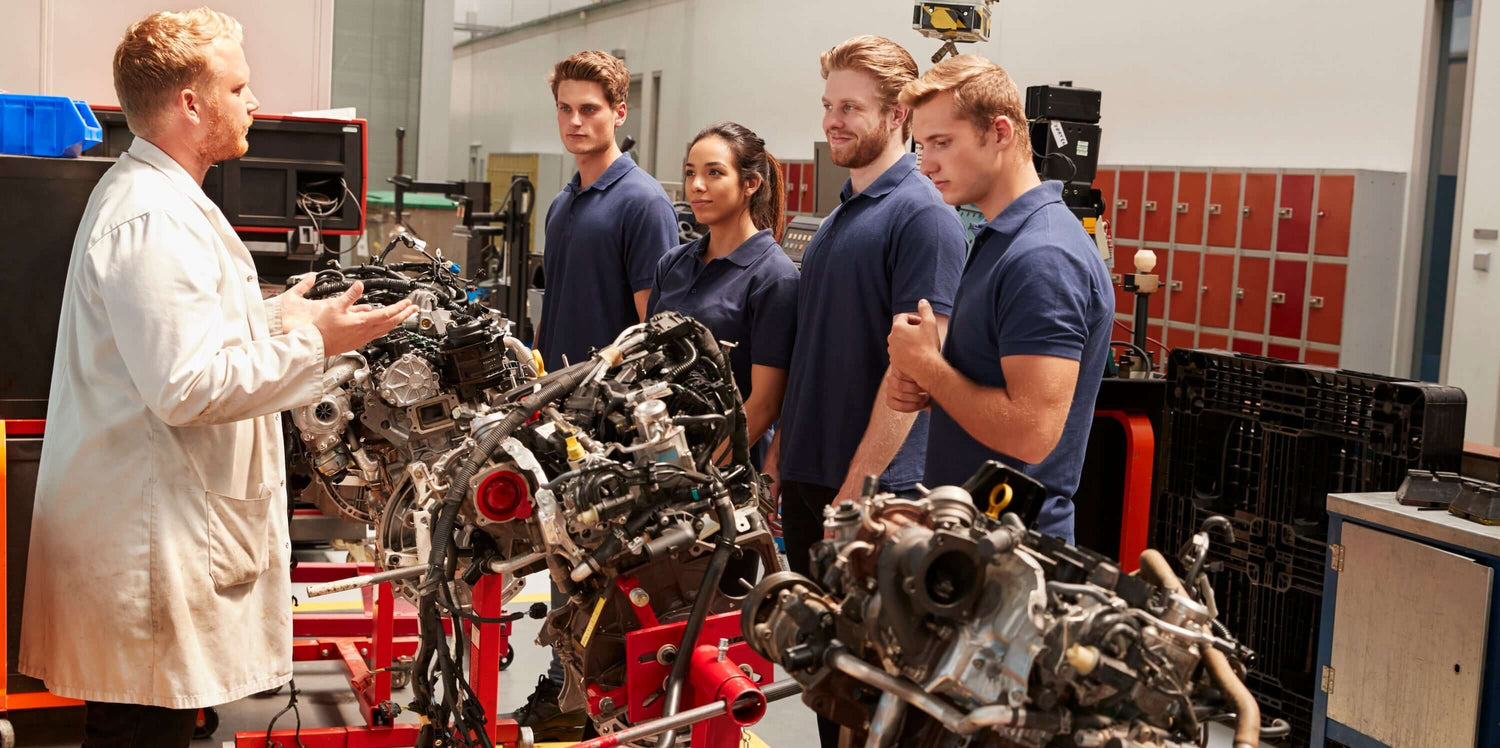

Dodge engines come in more flavors than most manufacturers, and the install procedure that works on one Dodge family doesn't always translate cleanly to another. A 5.7L HEMI swap in a Charger is a different job than a 3.6L Pentastar swap in a Caravan, which is different again from a 5.9L Magnum swap in an older Ram. The mechanical work is conceptually similar across all of them, but the specific gotchas, the access challenges, and the platform-specific issues vary substantially.
This 2026 guide is the playbook our techs reach for when a Dodge engine lands on the bay. It covers what's consistent across the lineup, the family-specific quirks, and the prep that separates clean Dodge swaps from comebacks.
Identify What You're Installing
Dodge's modern engine catalog spans several distinct families. The 5.7L HEMI in Charger, Challenger, Durango, and Ram applications is the most common engine across multiple platforms. The 6.4L HEMI (392) in SRT applications and Ram 2500 trucks is its larger sibling. The 6.2L Supercharged HEMI in Hellcat and Demon applications is the performance variant. The 3.6L Pentastar V6 powers a wide range of mid-range Dodge applications. The 5.9L Magnum V8 was the workhorse in older Ram and Durango applications before the HEMI replaced it. The 4.7L PowerTech V8 lived in older Rams, Dakotas, and Durangos. The 5.9L and 6.7L Cummins diesels power heavy-duty Ram applications.
Each family has its own install considerations. Verify the engine before ordering. The eighth character of the Dodge VIN is the engine code. Cross-reference against the model year's specification chart. Then physically check the casting numbers on the block and head against what the VIN says. Mismatches indicate a previous swap.
For HEMI engines specifically, this matters more than for most platforms. The 5.7L HEMI has had multiple production revisions — Eagle heads, MDS variants, non-MDS variants, VVT variants — and these aren't interchangeable across platforms even though they share displacement and family.
Pre-Install Inspection
Before any wrench touches the vehicle, inspect the replacement engine on the stand. Rotate the crankshaft one full turn by hand. Feel for tight spots, listen for any internal contact, confirm timing marks haven't moved in transit.
For 5.7L HEMI engines specifically, evaluate the lifter condition on a reman unit. The MDS (Multi-Displacement System) lifters are a documented weak point on HEMI applications, and a reman engine that didn't address them is shipping you a known future problem. Reputable rebuilders publish lifter replacement as part of the rebuild scope. Confirm in writing.
For 3.6L Pentastar V6 engines, check the cylinder head condition (especially left-bank heads on early production variants). The Pentastar had documented head issues in 2011–2013 production that progressed into reman supply if not properly addressed.
For 5.9L Cummins and 6.7L Cummins diesel engines, the inspection scope is more involved than gasoline V8s — injector condition, fuel pump condition, and turbocharger health all need verification on reman units.
Pulling the Old Engine
Dodge engine bays vary by platform. Charger and Challenger applications with HEMI engines have reasonably accessible engine bays with the engine coming out the top. Durango applications with the same engines drop the engine through the bottom on some configurations.
Ram truck applications with HEMI, Magnum, or Cummins engines have the most accessible engine bays in the entire Dodge lineup. The cab-on-frame architecture and the truck's tall hood opening make these the easiest Dodge engines to pull. The Cummins diesel specifically is the heaviest engine you'll encounter in regular Dodge service — plan for at least 1,300 pounds and use lift equipment rated accordingly.
Caravan and similar transverse-V6 applications drop the engine and transmission as an assembly through the bottom. Subframe drops with the engine. Lift required.
Disconnecting the Wiring
Dodge wiring connectors use Chrysler-pattern locks — a primary press-tab with a secondary slide or pull-lock that must be released before the primary tab. Forcing a connector with the secondary lock set breaks the locking mechanism.
Photograph every connector. Label with painter's tape. The cam position sensors, the variable valve timing solenoids on VVT-equipped HEMI variants, and the various coolant sensors all use similar small connectors that are easy to misroute.
For HEMI applications with MDS, the MDS solenoid connectors need specific attention. Cross-routed MDS connectors after a swap produce immediate driveability issues.
The main engine harness routes through a firewall bulkhead on most modern Dodge applications. Locate it, release the locking mechanism, and pull the connector straight back.
Prepping the Replacement on the Stand
Transfer accessory brackets, alternator, power steering pump, A/C compressor, and any sensors not pre-installed. Use new torque-to-yield bolts where Dodge specifies them — flexplate bolts and many timing-related fasteners are TTY and shouldn't be reused.
For HEMI engines, replace the spark plugs (16 of them on V8 HEMI applications — each cylinder has two plugs). Reusing old plugs on a fresh engine is a false economy.
For Pentastar V6 engines, inspect and replace the oil cooler if the engine has high mileage history. The Pentastar oil cooler is a documented leak point and replacing it during the swap is far easier than after.
For Cummins diesel engines, the prep includes the injector verification, the fuel filter replacement, and the air intake system inspection. Cummins engines have more pre-install verification than gasoline engines because the failure modes are more expensive.
Install a new oil filter and pre-fill the oil galleries. For HEMI applications, the oil pickup tube and the oil pump need to be primed before the first crank.
The Drop-In
Lower the engine into the bay slowly. For HEMI applications in Charger and Challenger, the engine drops into place with the transmission disconnected. Engine mount bolts go in finger-tight, then torqued after everything settles.
For Ram truck applications with the engine coming in from above, the alignment is straightforward but the engine size requires careful attention to clearance on the radiator support and the firewall.
For Caravan and similar transverse applications, the engine-and-transmission-as-assembly installation is the reverse of removal. Subframe bolts go in last, with Dodge's specified torque values.
Wiring and First Start
Before the first crank, connect a scan tool capable of communicating with the Dodge PCM and verify sensor data. Coolant temp matches ambient. Intake air temp matches ambient. MAP reads atmospheric. Crank and cam position sensors present in the data list.
For the first crank, pull the fuel pump relay and crank for ten to fifteen seconds to build oil pressure. HEMI engines build pressure quickly when the oil galleries are properly primed — you should see at least 25 psi within seven seconds. If pressure doesn't build, stop and investigate.
For Cummins diesel applications, the start procedure is different. Prime the fuel system through the priming pump on the fuel filter housing. Confirm rail pressure builds on the scan tool. Then crank.
Reset the fuel system, crank, and let the engine fire. Don't rev. Watch the scan tool for the first five minutes of idle.
Break-In and First 500 Miles
Walk the customer through break-in before they leave the shop. First 30 minutes of run time should be varied-speed driving in the 25–55 mph range, not sustained idle or sustained highway cruise. First 500 miles avoid full-throttle operation, sustained high RPM, towing, and aggressive cold starts.
For HEMI applications specifically, avoid MDS operation during the first 50 miles — the MDS transition cycles add load variation that the rings need time to adjust to. Most HEMI applications can have MDS disabled during break-in through the scan tool or a tune.
Schedule a 500-mile return for the first oil change. Use Dodge-specified oil weight — 5W-20 for most modern HEMI applications, 0W-20 for some Pentastar variants, 15W-40 for Cummins diesel.
What Sets Clean Dodge Installs Apart
Dodge engines reward methodical work. Verify casting numbers. Address platform-specific known issues (HEMI lifters, Pentastar oil cooler, Cummins injectors). Use new torque-to-yield bolts. Pre-lubricate oil galleries. Confirm sensor data before first crank.
For sourcing the long block, our Dodge engines catalog publishes casting numbers and platform fitment so the verification step happens before purchase, where it belongs.