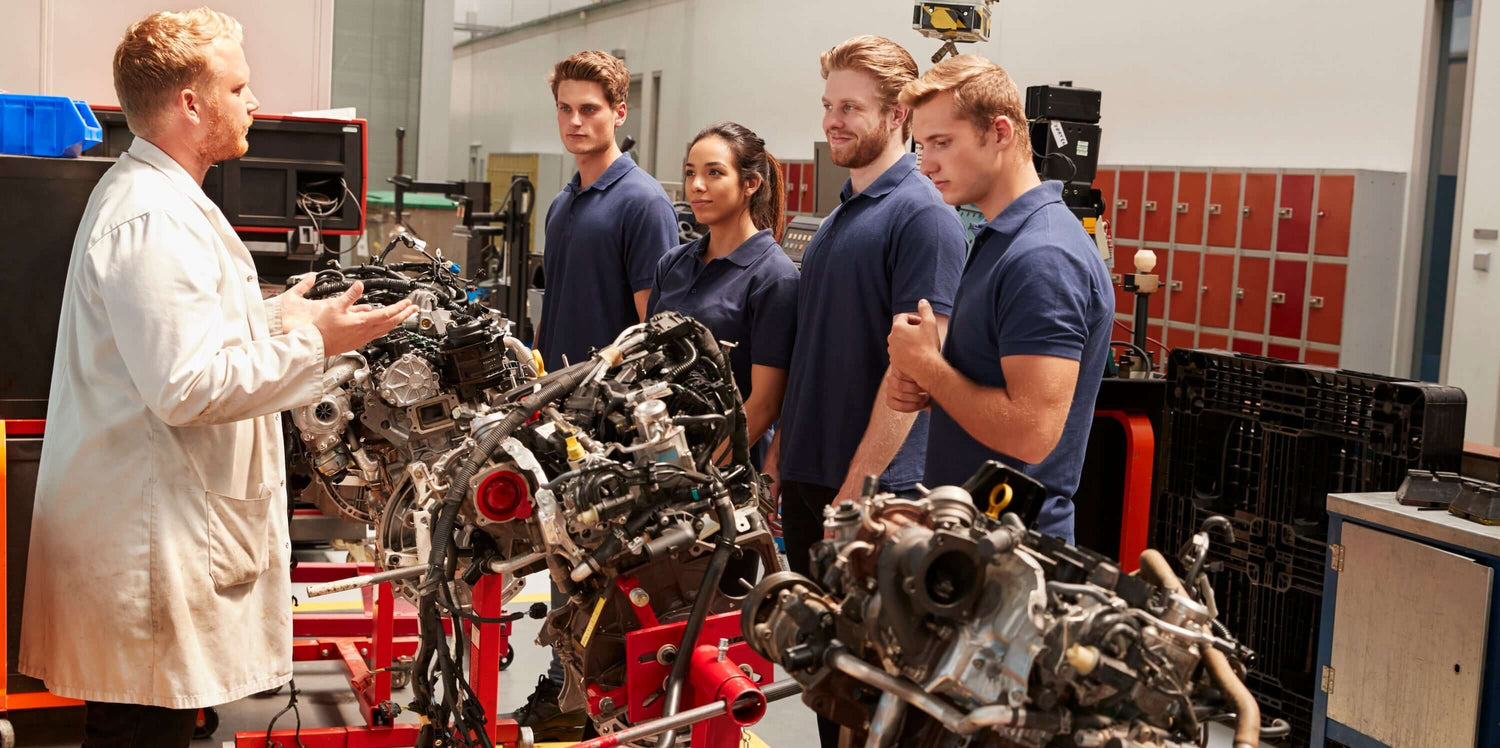

Honda's engine specification system is one of the cleanest in the industry once you learn to read it, but "clean" doesn't mean "simple." The same Honda model year can have shipped with two or three different engine variants depending on trim, regional certification, and production date. Within each variant, casting changes happened mid-production with consequences that show up at install time if you didn't catch them at order time. The Honda enthusiast community has been decoding these specifications for decades, and there's a reason — they actually matter.
This guide walks through how Honda engine specifications work, how to read them, and what compatibility really means when you start sourcing replacement engines. If you've ever stared at two seemingly identical Honda engines and wondered why one fits and the other doesn't, here's the framework.
How Honda Names Its Engines
Honda engine codes follow a consistent pattern once you know how to read them. The first letter identifies the engine family. The numbers indicate displacement in tenths of a liter. The final letters describe valvetrain configuration and production variant.
K20A: K-family, 2.0 liter, base "A" variant. K20A2: K-family, 2.0 liter, performance variant 2 (RSX Type-S, EP3 Civic Si). K20Z3: K-family, 2.0 liter, performance variant 3 (FA5 Civic Si, FG2 Civic Si). K24A1: K-family, 2.4 liter, variant 1 (TSX). K24Z3: K-family, 2.4 liter, late variant 3 (later Accord, TSX). J35Z2: J-family, 3.5 liter, variant 2 with VCM. R18A1: R-family, 1.8 liter, variant 1 (Civic). L15B7: L-family, 1.5 liter, performance variant 7 (Civic 1.5T, CR-V 1.5T).
The codes carry actual information. The first letter and the displacement identify the family. The variant letter and number identify the production specification. Two engines with the same first three characters and different variant suffixes are not the same engine — different valvetrain, different ECU calibration, sometimes different internals.
Reading Your VIN for the Factory Engine Code
The eighth character of the Honda VIN is the engine code. The exact decoding varies by model year, but Honda publishes the cross-reference chart for each year and third-party VIN decoders are reliable. Punch your VIN into a Honda-specific decoder and confirm the engine family and variant the vehicle was built with.
The factory engine code is the baseline. It tells you what the vehicle was certified with, what emissions configuration is expected, and what parts the original assembly line installed. That information is the starting point for any replacement conversation.
Casting Numbers: What's Actually There
VIN decoding tells you the factory-correct engine. The casting numbers on the engine itself tell you what's physically installed right now.
On most Honda engines, the engine identification stamp is on the front of the block near the timing cover. The block casting number is cast into the metal of the block, typically visible from the bell housing side. The cylinder head casting numbers are visible on the head when the valve cover is off, and sometimes from the outside near the spark plug bores.
Compare the casting numbers to Honda's specification chart for your engine family. If they match the factory spec, the engine is the one Honda installed at the factory. If they don't match, the vehicle has had an engine swap at some point, and the replacement should match what's currently installed — not what the VIN says.
This matters more for Honda than for most manufacturers because of the active swap culture. A Civic that started life with a D-series might now have a K-series under the hood. An Accord that started with a J30 might now have a J35. A vehicle's VIN doesn't track these changes. The casting numbers do.
What Compatibility Actually Means
Two Honda engines being compatible is more than "will they bolt up." Compatibility breaks into four separate questions.
Physical fitment: Will the engine fit the engine bay, mount to the existing crossmember and motor mounts, and align with the transmission bell housing? Honda engine bays are generally compact, and what fits a 2008 Civic might not fit a 2010 Civic even when the engine appears similar.
Driveline compatibility: Does the flexplate or flywheel pattern match the transmission? For Honda CVT applications specifically, this is a more sensitive question than for conventional automatics. The CVT torque converter equivalent has specific compatibility requirements that aren't always documented in casual listings.
Electrical and ECU compatibility: Does the engine harness mate to the vehicle's body harness? Does the ECU communicate on the right protocol with the vehicle's other modules? Year-mismatched Honda swaps frequently run into CAN bus compatibility issues that look fine on paper but fail in practice.
Emissions compatibility: Does the engine bring all of the emissions equipment the vehicle was certified with? This is the compliance angle that becomes determinative in CARB states and during state inspections elsewhere.
The Three Most Common Honda Compatibility Mistakes
First mistake: assuming all K-series engines are interchangeable. K20A, K20A2, K20A3, K20Z3, K20Z4, K20C1, K24A1, K24A2, K24A4, K24Y2, K24Z3, K24Z7 — these are all "K-series" but vary substantially in internal specification, ECU requirements, and platform fitment. Don't buy by displacement; buy by full engine code.
Second mistake: ignoring the J35 variant differences. The J35 V6 has at least eight production variants over its life. Some have VCM, some don't. Some have timing belts, some have timing chains. Some have specific emissions equipment, others don't. The J35Z3 in a 2008 Pilot is not the same engine as the J35Y4 in a 2014 Pilot.
Third mistake: confusing JDM engine codes with US-market equivalents. A JDM K20A and a US-market K20A may share a name but differ in emissions equipment, ECU calibration, and accessory configuration. JDM engines are real options for some Honda applications but the compatibility check is more involved than for US-market engines.
The K-Swap Engine Code Cheat Sheet
For K-series engines specifically, the engine code identifies the platform of origin and the performance characteristics.
K20A: Japanese-market base 2.0L. Higher compression than US variants in many configurations.
K20A2: US-market RSX Type-S and EP3 Civic Si. Performance camshafts, higher compression, manual transmission pairing.
K20A3: US-market RSX base and EM2 Civic Si. Less aggressive cams, automatic transmission compatibility, lower power output.
K20Z3: US-market FA5 Civic Si and FG2 Civic Si. Refined K20A2 successor with improved emissions and slightly different power characteristics.
K20Z4: JDM Civic Type R. High-performance variant rare in US-market builds.
K20C1: US-market FK8 Civic Type R and FL5 Civic Type R. Modern turbocharged K-series, substantially different from naturally-aspirated K20 variants.
K24A1: US-market TSX. Detuned K24 with TSX-specific cams and emissions.
K24A2: US-market TSX higher-trim and certain Accord applications. Performance variant with improved cams.
K24A4: US-market Accord, Element, CR-V. Truck-tuned for low-end torque.
K24Z3: Late US-market Accord and TSX. Updated emissions and minor internal revisions from K24A2.
Each code identifies a specific engine. They aren't interchangeable across platforms without significant swap work.
The Practical Sourcing Workflow
Step one: decode your VIN. Note the factory engine code.
Step two: physically inspect the engine in the vehicle and record block and head casting numbers. Compare to factory spec.
Step three: source a replacement that matches the casting numbers in the vehicle, not just the displacement. If the vehicle has had a prior engine swap, replace what's installed.
Step four: confirm transmission pairing. Honda engines paired with multiple transmissions over their production life can have different flexplate or flywheel patterns depending on the transmission target.
Step five: confirm fitment with the supplier before ordering. Reputable suppliers will verify against your specific VIN before shipping.
The Honda engines on our catalog publish casting numbers, platform fitment, and transmission compatibility upfront, so the verification step happens before purchase rather than at the engine stand. That's not a special service — it's the minimum that should be true of any Honda engine listing you trust enough to order from. The compatibility questions have clean answers. The trick is asking them before the engine ships.