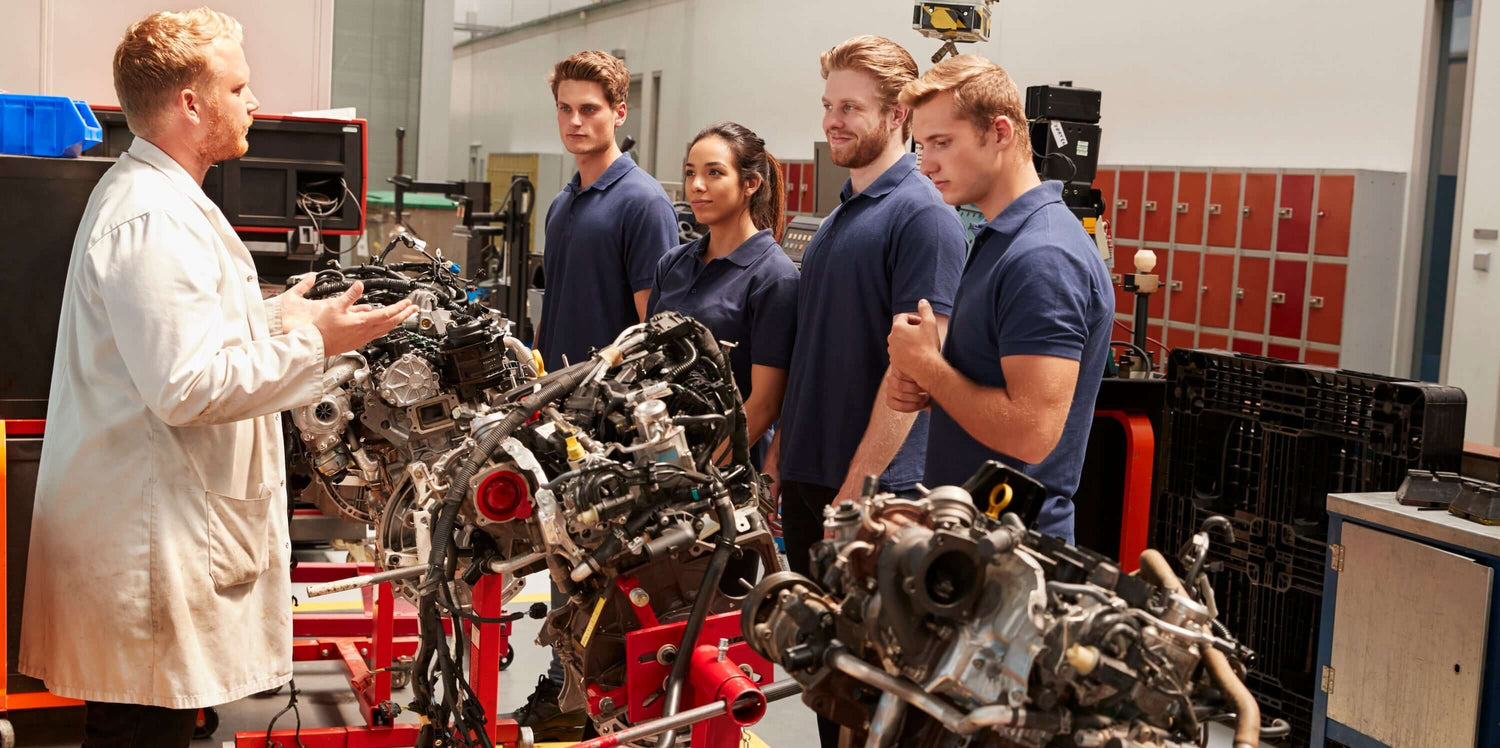
BMW's engine specification system is one of the most internally consistent in the industry, but "consistent" doesn't mean "easy." The codes carry real information, the variants matter substantially within each family, and the differences between similar-sounding engines (N54 versus N55, N20 versus B48, S65 versus S62) determine fitment outcomes in ways that aren't always obvious to people coming from American or Japanese platforms.
This guide walks through how BMW engine specifications actually work, how to read them, and what compatibility really means when you start sourcing replacement engines.
How BMW Names Its Engines
BMW engine codes follow a consistent pattern. The first letter identifies the engine family. The next two characters indicate cylinder count and configuration. The remaining characters indicate displacement and variant.
N54B30: N-family (introduced with the Valvetronic era), 5 (cylinder count indicator), 4 (specific platform within family), B (gasoline), 30 (3.0L displacement). S65B40: S-family (M Performance), 6 (cylinder count indicator), 5 (specific platform), B (gasoline), 40 (4.0L). B58B30: B-family (newer, modular), 5 (cylinder count indicator), 8 (specific platform), B (gasoline), 30 (3.0L).
The first letter identifies the engine family generation: M-family (older, pre-Valvetronic), N-family (Valvetronic era), S-family (M Performance), B-family (modular, newer). The cylinder count indicator and platform identifier together identify the specific engine within the family. The displacement number tells you the engine's nominal size.
The codes carry meaningful information. Two engines with similar-looking codes can have substantial differences. N54B30 and N55B30 are both "3.0L straight-six BMW engines" but use different turbocharging (twin versus single), different fueling systems, and different ECU calibrations.
Reading Your VIN for the Factory Engine Code
The seventeenth digit of the BMW VIN identifies the engine code position. BMW's online VIN decoder, RealOEM, and other third-party BMW-specific tools confirm the factory-correct engine variant.
The factory engine code is the baseline. It tells you what the vehicle was certified with, what emissions configuration is expected, and what parts the original BMW assembly line installed.
Casting Numbers: What's Actually There
VIN decoding tells you the factory-correct engine. Casting numbers on the engine itself tell you what's physically installed right now.
On most BMW engines, the engine identification stamp is on the front of the block near the timing cover or on the bell housing flange. The block casting number is cast into the metal. The cylinder head casting numbers are visible from the head when the valve cover is off.
Compare casting numbers to BMW's specification chart for your engine family. If they match the factory spec, the engine is the one BMW installed at the factory. If they don't match, the vehicle has had an engine swap at some point, and the replacement should match what's currently installed.
The Major BMW Engine Families
The big-picture catalog of modern BMW engines breaks into these families.
The M-family (pre-Valvetronic) includes the M54 straight-six (2000–2006, E46 3-series, E39 5-series, others) and earlier M-coded engines like the M50, M52, S52 (E36 M3), and S54 (E46 M3). These engines lack Valvetronic and direct injection, which makes them simpler and generally more durable than their successors.
The N-family includes the N52 naturally-aspirated straight-six (2006–2013, with Valvetronic), the N54 twin-turbo straight-six (2007–2010, the first BMW twin-turbo six), the N55 single-turbo straight-six (2010–2017), the N20 four-cylinder turbo (2012–2017), and the N63 V8 twin-turbo (2009–present in various forms).
The S-family (M Performance variants) includes the S65 V8 (2008–2013 M3 E90/E92/E93), the S62 V8 (2000–2003 M5 E39), the S85 V10 (2006–2010 M5 E60 and M6 E63), the S55 twin-turbo straight-six (2014–2020 M3 F80 and M4 F82), the S63 V8 twin-turbo (2010–present in M5 and M6 applications), and various other M-engines.
The B-family includes the B48 four-cylinder turbo (2014–present in current 3-series and other applications), the B58 single-turbo straight-six (2016–present, the current BMW six-cylinder), the S58 M-variant of B58 (2019–present in current M3 G80 and M4 G82), and the B57/B47 diesel variants.
What Compatibility Actually Means
Two BMW engines being compatible for a swap breaks into four separate checks.
Physical fitment: Will the engine fit the engine bay, mount to the existing crossmember, and align with the transmission bell housing? BMW engine bays are typically tight and the mounting interfaces are BMW-specific. Engine mounts, oil pan clearance, hood clearance, and accessory drive routing all live here.
Driveline compatibility: Does the engine's flexplate or flywheel pattern match the transmission? BMW transmissions vary substantially across the lineup — the ZF 6HP and 8HP automatics, the various manual transmission options, and the M-DCT dual-clutch units all have specific compatibility requirements.
Electrical and ECU compatibility: Does the engine's wiring harness mate to the vehicle's body harness? Does the ECU communicate on the right protocol with the vehicle's other modules? Year-mismatched BMW swaps frequently run into CAN bus compatibility issues that look fine on paper but fail in practice.
Emissions compatibility: Does the engine bring all of the emissions equipment the vehicle was certified with? This is the compliance angle that becomes determinative in CARB states.
The Three Most Common BMW Compatibility Mistakes
First mistake: assuming N54 and N55 engines are interchangeable. They share displacement and appear similar in listings but use fundamentally different turbocharging systems (twin versus single) and different fueling architectures. They are not direct substitutes.
Second mistake: ignoring M-engine variant differences. S65 production years span 2008–2013 with subtle revisions. S55 has multiple production variants. Match production years carefully when sourcing M-platform replacements.
Third mistake: confusing European-spec engines with US-spec equivalents. Same engine code, different emissions equipment, different ECU calibration. European-spec replacement engines require careful compatibility verification before installation in US-market vehicles.
The Practical Sourcing Workflow
Step one: decode your VIN. Note the factory engine code.
Step two: physically inspect the engine and record block and head casting numbers and the engine code stamp. Compare to factory spec.
Step three: source a replacement that matches the engine code and casting numbers, not just the displacement family.
Step four: confirm transmission pairing. BMW engines paired with multiple transmissions across years can have different flexplate patterns depending on the transmission target.
Step five: confirm fitment with the supplier before ordering.
The BMW engines on our catalog publish engine codes, casting numbers, platform fitment, and transmission compatibility upfront, so the verification step happens before purchase. The BMW market is precise. The supplier discipline needs to match it.