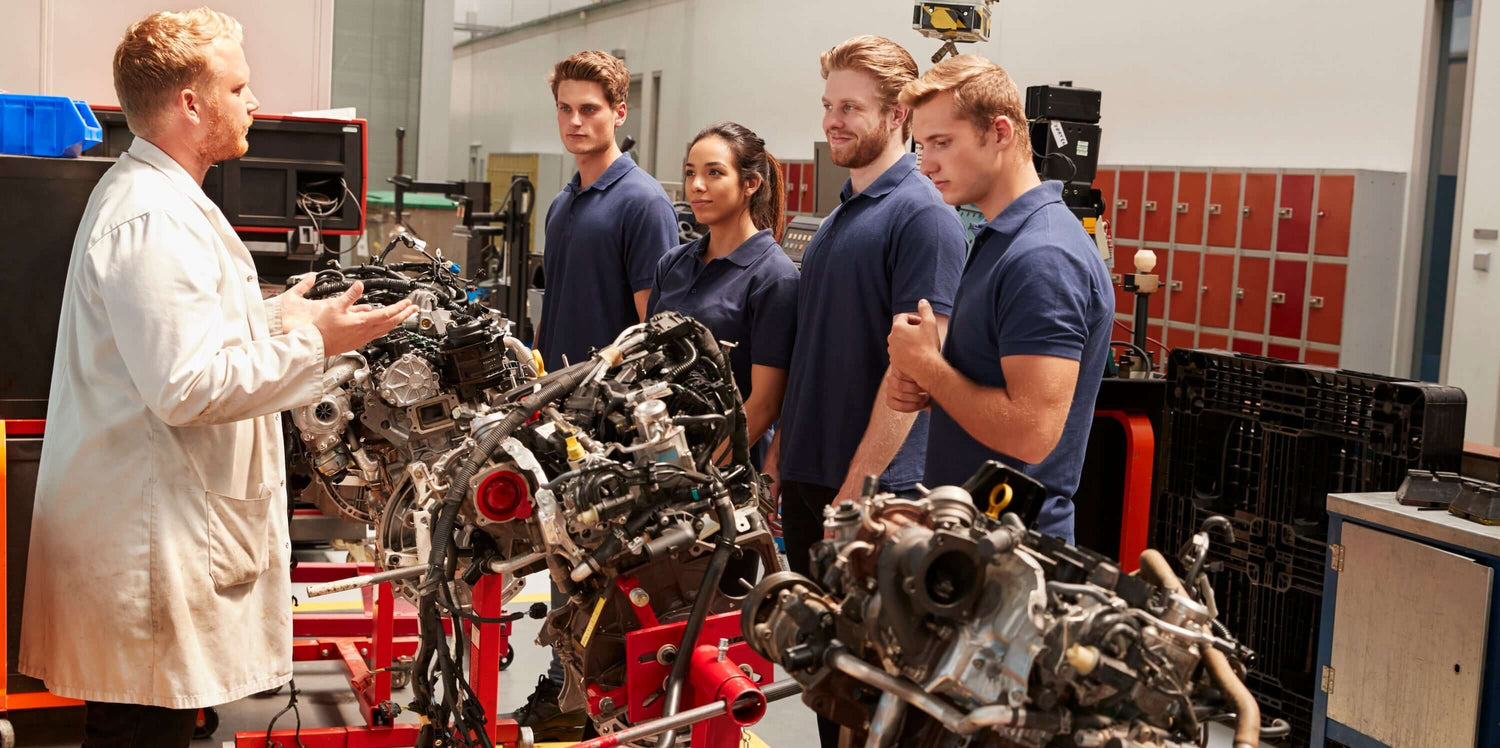
BMW has produced some of the most engineering-impressive engines in the modern automotive era and also some of the most problematic. The badge doesn't predict reliability. The specific engine family does, and the variation between BMW engine families is substantial enough that an honest reliability conversation has to start with engine codes, not BMW badges.
Here's the honest ranking of the most reliable BMW engine models worth buying in 2026, based on what's still running in the field, what's available to source, and what shops keep recommending when customers ask which engine they should look for.
1. The M54 Straight-Six (2000–2006)
The M54 naturally-aspirated straight-six in the E46 3-series, E39 5-series, E60 5-series early production, Z3, Z4, and X3 applications is one of the most quietly reliable BMW engines of the modern era. Cast iron block, aluminum head, dual VANOS variable valve timing, no direct injection, no turbocharging, no Valvetronic.
What goes wrong: the disa valve in the intake manifold fails past 80,000–120,000 miles (inexpensive replacement). The VANOS solenoids can stick or fail (inexpensive to address). Cooling system components — water pump, thermostat, expansion tank — are essentially scheduled service items past 80,000 miles. Valve cover gasket leaks are routine.
None of those are engine-killers. The underlying M54 bottom end is mechanically excellent and routinely runs to 250,000+ miles with consistent maintenance. The M54 is the BMW engine you buy when you want a BMW that doesn't need an engine.
Supply: variable. Reman supply for the M54 has thinned as the platform ages, but used cores remain available from E46 and E39 donor vehicles.
2. The N52 Straight-Six (2006–2013)
The N52 naturally-aspirated straight-six is the M54's successor and continues the reliability story. Magnesium block (with steel cylinder liners), aluminum head, Valvetronic, dual VANOS. Powers E90/E91/E92/E93 3-series, E60 5-series later production, E70 X5 (3.0L variant), Z4, and other applications.
What goes wrong: the Valvetronic system has known issues with the eccentric shaft sensor (inexpensive replacement). Coolant leaks from the same components as the M54 — water pump, thermostat housing, expansion tank. Valve cover gasket leaks. Oil pan gasket leaks on high-mile examples.
Mechanical bottom end is generally excellent, similar to the M54. The N52 doesn't have the platform-defining failure modes that plague some BMW engines. For owners of N52-equipped vehicles, the engine is among the better reliability choices in the BMW catalog.
Supply: reasonable in 2026. The N52 production years are large and the donor pool from multiple shared platforms keeps inventory adequate.
3. The S54 Straight-Six (E46 M3, 2000–2006)
The S54 in the E46 M3 is the M-engine that defined a generation of BMW performance enthusiasts. Naturally aspirated, high-revving, individual throttle bodies on each cylinder, the soundtrack that made the E46 M3 famous. And mechanically excellent for an M-engine — the S54 lacks the rod bearing issue that plagues the later S65, and the engine architecture is durable enough that S54s routinely run past 150,000 miles with consistent maintenance.
What goes wrong: the VANOS solenoids and the VANOS unit itself have documented service needs past 80,000–100,000 miles. The connecting rod bolts have been a topic of discussion in the BMW community — BMW issued a service bulletin on inspection. Cooling system service items.
For E46 M3 owners committed to the platform, the S54 is the right answer for engine replacement when needed. The platform has collector value and the engine is fundamental to the car's character.
Supply: limited. The E46 M3 is a specialty vehicle and S54 supply requires sourcing from M-specialist rebuilders or careful used core sourcing.
4. The N55 Single-Turbo Straight-Six (2010–2017)
The N55 is the N54's single-turbo successor and addresses several of the N54's issues. Single twin-scroll turbo (more reliable than the N54's twin turbos), Valvetronic added, improved HPFP design. Powers E90/E92 335i late production, F30 335i/340i, E60 535i, E70 X5, and various other applications.
What goes wrong: valve cover oil leaks past 100,000 miles. Carbon buildup on intake valves (the direct injection issue that affects the N54 also affects the N55 but less severely). Occasional charge pipe failures. Oil filter housing gasket leaks.
The N55 long block is mechanically more durable than the N54 long block, and the engine has aged into reasonable reliability over its production years. For owners of N55-equipped BMW vehicles, the platform is among the better modern BMW choices.
Supply: strong in 2026. Reman and used core availability is good across the N55 production years.
5. The B58 Single-Turbo Straight-Six (2016–Present)
The B58 is BMW's current-generation straight-six and represents the engineering refinement of decades of BMW straight-six development. Closed-deck block design, integrated exhaust manifold, port-and-direct combined fueling (which addresses the carbon buildup issue that plagued earlier direct-injection BMW engines), improved turbo design.
For owners of newer BMW vehicles with B58 engines, the platform has aged well in its first decade of production. The known issues are relatively minor and the underlying engine is mechanically excellent.
Supply: still developing in 2026 as the B58 works through its production years. Reman availability is growing but is not yet at the level of older platforms. New crate options remain available from BMW.
What to Approach With Caution
For honest balance, the BMW engines that haven't aged as well: the N63 V8 (2009–2013 production years, with multiple simultaneous issues across timing components, injectors, valve seals, and turbos); the S65 V8 in 2008–2013 M3 (rod bearing issue requires addressing); the S85 V10 in 2006–2010 M5 and M6 (rod bearing issues plus throttle actuator failures plus general parts cost considerations); and the N54 in early production years (multiple known issues affecting wastegates, HPFP, and carbon buildup).
None of these are unsalvageable engines, but the cost of bringing them up to long-term reliability is substantial. The S65 and S85 in particular have collector status that justifies the investment for M owners committed to the platform; for owners considering whether to invest, the math is more individual.
The Sourcing Picture
The most reliable BMW engine to buy depends on the platform you're keeping. An M54 is the answer for E46 3-series and E39 5-series applications. An N52 is the answer for E90 3-series, E60 5-series late production, and various 6-cylinder BMW applications from 2006–2013. An N55 is the answer for E90/F30 335i, F30 340i, and similar single-turbo straight-six applications. An S54 is the answer for E46 M3. A B58 is the answer for current-generation 3-series, 4-series, and other modern BMW applications.
For all of them, sourcing from a supplier with documented warranty terms and BMW-specific expertise is the step that determines whether the swap delivers the reliability the platform is capable of. The BMW engines on our catalog are matched by engine code and platform fitment, with rebuild scope addressing BMW-specific known issues disclosed upfront. The platform is precise. The supplier discipline needs to match it.